
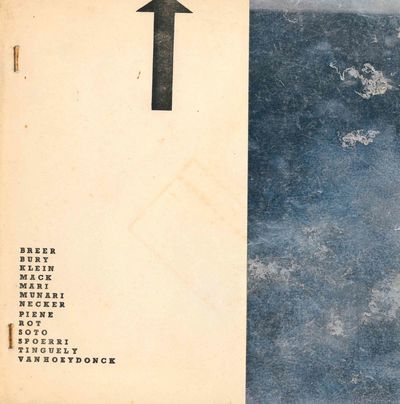
Motion in Vision/Vision in Motion
Unpaginated (26 pp.) catalogue published on the occasion of the landmark exhibition at the Hessenhuis in Antwerp, held from March 21 to May 3, 1959. Square octavo (8 1/4 x 8 1/4 inches). Original side-stapled wrappers. Light rubbing to aluminum leaf, slight rust-staining around staples, scattered foxing, back cover loose, overall very good. Antwerp: Hessenhuis, 1959. The ZERO group was founded in Düsseldorf by Otto Piene and Heinz Mack. Their aim, Piene once wrote, was to create "a zone of silence and of pure possibilites for a new beginning." In contrast to the popular Abstract Expressionist movement, ZERO artists championed kinetic and light elements such as chrome, aluminum, latex, and motors. Contemporaneous groups existed in other parts of Europe and Asia, as well as the Americas, including the Nul group in the Netherlands, the Nouveaux Réalistes in France, Azimuth in Italy, and the Gutai group in Japan. According to an article on the group, "No longer certain that painting best represented the modern age, Piene, Mack, and Uecker developed a new visual language based on science and a poetic existentialism. Many of the works that emerged used light, colour and movement rather than solid materials to convey the visionary potential of science, while also reflecting Cold War anxieties. As the artists' friend and champion Yves Klein wrote, 'We are living in the atomic age, where everything material and physical could disappear from one day to another, to be replace by nothing but the ultimate abstraction imaginable.'" (Heroes of Zero: the art collective that inspired a generation, Christies.com, 2022) In 1959, the ZERO group held their first exhibition which introduced them to the international public. This catalogue was published in conjunction with that exhibition. The exhibition was artist-curated, and included the participation of Robert Breer, Pol Bury, Yves Klein, Heinz Mack, Enzo Mari, Bruno Munari, Günther Uecker (spelled "Necker" on the cover), Otto Piene, Diter Rot, Jesús Rafael Soto, Daniel Spoerri, Jean Tinguely, and Paul Van Hoeydonck. Contributors to the catalogue, which was edited by Marc Callewaert, included Emmet Williams, Heinz Mack, Otto Piene, Pol Bury, Dieter Rot, Jean Tinguely, and Paul Van Hoeydonck. These include paper cuttings, a silver aluminum leaf, tipped-in illustrations, and a letterpress page. Very scarce; as of February 2024, OCLC only locates two holdings of this important catalogue in North America.- $2,500
- $2,500
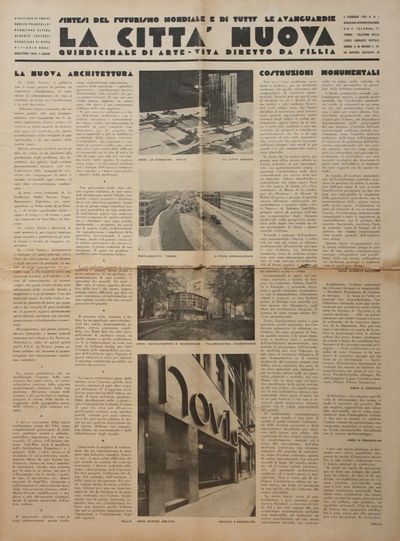
La Città Nuova. Quindicinale di Arte-Vita Diretto da Fillia (Later subtitles: Quindicinale di Architettura and Quindicinale di Architettura e Arte)
Torino, 1932-1934. Tabloid/folio (approx. 56 x 41.5 cm). Original self-wrappers; each issue 8 pp. Some browning to paper, toning, light scattered foxing, some issues with tears along fold lines, overall good condition. Twelve issues in eleven fascicules (Year I, Nos. 1 and 3-6; Year III, Nos. 3-9) of the important Italian Futurist architecture journal, under the direction of Fillia, a leader in the Futurist movement, with editorial assistance and contributions from other noted Futurist artists and figures including Alberto Sartoris, Enrico Prampolini, Nicolay Diulgheroff, Gino Levi-Montalcini, Mino Rosso, Gerardo Dottori, Filippo Marinetti, Walter Gropius, Le Corbusier, Bruno Sanzin, Emilio Odorizio, Pippo Oriani, Italo Lorio and many others, covering topics in domestic and international architecture including functional architecture, modern furniture design, aeropainting, Futurist landscape painting, public architecture, contemporary church architecture, African architecture, urbanism and ruralism, kitchen design, iron construction, Fascist architecture, new building construction in Spain, and many others. Illustrated throughout primarily from photographs. Fillia (Luigi Colombo) helped to establish the Futurist movement in 1923, and quickly became the group's leader and its principal theorist. He published a number of journals including Futurismo, Ventrina Futurista, La Città Futurista, Stile Futurista, and La Città Nuova, co-authored the Manifesto of Futurist Cooking with Marinetti, and designed the Futurist Pavilion at the 1928 International Exhibition in Turin. An excellent and scarce example from the height of the Futurist movement; as of October 2023, OCLC locates only four holdings in the United States.- $6,000
- $6,000
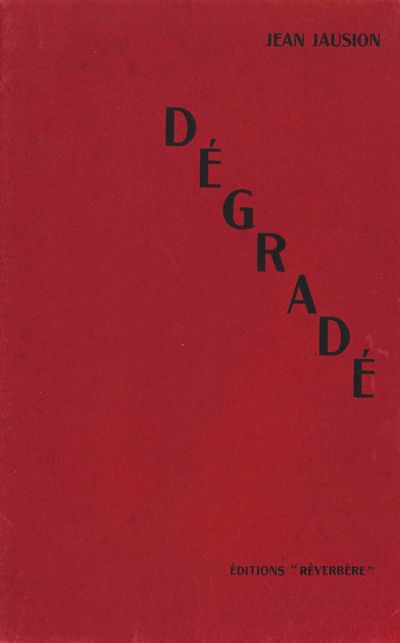
Dégradé. Suivi de Théâtre des marionnettes, avec une composition de Jean Marembert
Jausion, Jean Paris: Éditions Réverberes, 1928. Octavo (21 ×13.5 cm). Original printed wrappers; unpaginated (33 pp.) including a frontispiece after a drawing by Jean Marembert. Overall very good condition. Limited edition of 300 copies. Rare volume of poems published by the neo-Dadaist group Les Réverbères, which was founded in December 1937 by Michel Tapié, Jean Marembert, Jacques Office, Pierre Minne, and Henri Bernard, and which promoted Dadaist exhibitions, jazz concerts, stage performances, and published literary works. Among the exhibitors were: Louis Cattiaux, Marembert, Pierre Minne, Tapié, as well as members of the "La Main à plume" surrealist group: Noël Arnaud, Marc Patin, Jean-François Chabrun, and others. Among other events, the group also organized "Tribute to Dada" soirées, which featured readings of texts by Tristan Tzara, Ribemont-Dessaignes, and others. In "Art of the Defeat: France 1940-1944," Laurence Bertrand Dorléac asserts that the group still met for several gatherings retaining the spirit of the 1930s even after the German occupation of France in June 1940. The Neo-Dadaist activities around Michel Tapié have not been explored to any significant degree and are rarely mentioned in passing in the literature on Dada and Surrealism. One exception is Michel Fauré's book "Histoire du surréalisme sous l'Occupation", published in 1982. The reason for the sparse state of research is probably that the experimental, elaborate avant-garde prints, most of which were produced in very small editions, are hardly accessible due to their rarity. Very scarce; as of December 2023, OCLC lists only 2 copies in North America.- $750
- $750
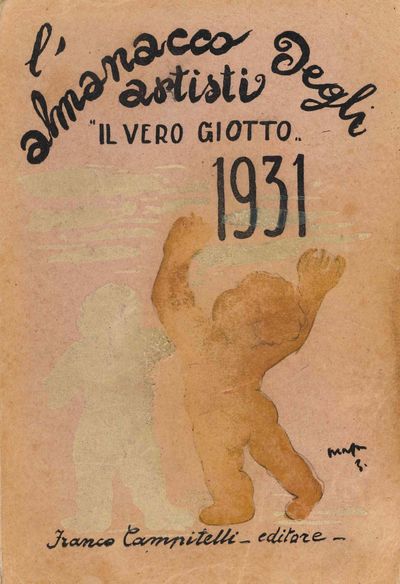
L’Almanacco degli artisti “Il Vero Giotto” 1931
Roma/Foligno: Franco Campitelli, 1931. Duodecimo (19.2 x 13.2 cm). Original illustrated wrappers with cover illustration by Mario Mafai; (2), 432, (4) pp. Some signatures coming loose from binding, overall very good. A small Futurist Italian art almanac, conceived of and compiled by Carlo d'Aloisio da Vasto. This volume features a colver illustration by Mario Mafai and writings by Luciano Folgore, Corrado Pavolini, Luigi Bartolini, C. Govoni, Alfredo Casella, G.B. Angioletti, Alberto Sartoris, Massimo Bontempelli, Vincenzo Costantini, Gerardo Dottori, Anton Bragaglia, and others, as well as illustrations by numerous artists including Morandi, De Pisis, Carrà, Casorati, Soffici, Spadini, and A. Martini. Other volumes were published in 1930 and 1932, but as of October 2023, OCLC locates only 2 holdings of the 1931 almanac in North American libraries.- $150
- $150

Dames et Generaux. With 10 etchings in color by Baj signed and numbered
Milan, 1964 Berggruen, Paris & Schwarz, Milan, 1964. This book is made up of a collection of ten etchings with aquatint in color by Enrico Baj, signed and numbered in pencil, to accompany ten poems of Benjamin Peret chosen by Tristan Sauvage from the collection De derrière les fagots. It includes a foreword by Andre Breton and a false title in facsimile by Marcel Duchamp. Limited numbered edition of 125 copies in Velin d'Arches and Velin de Rives for the etchings of with this copy is one of the 89 copies. Signed in colophon by Andre Breton and Enrico Baj in pencil. Loose as issued, complete, guarded in the original slipcase in cloth with strips design, beige on beige, and small decorative tassel in white, matching hard chemise. In very good conditions- $3,000
- $3,000
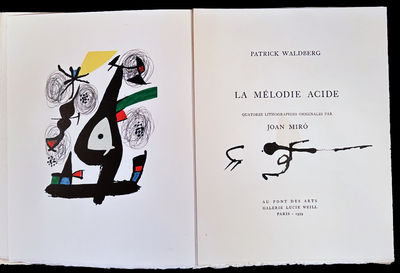
La Melodie Acide. With 14 original lithographs by Miro.
Patrick Waldberg Paris, 1976 Au Pont des Arts, Paris 1976. Text by Patrick Waldberg, illustrated by Miro with 14 original lithographs in color. Complete portfolio in Arches paper limited in 145 numbered copies of which this one is one of the seven in Roman numbers reserved for the collaborators. Signed by Patrick Waldberg and by Miro in pencil on the justification page. Loose as issued in the original Arches pictorial wrappers guarded in the original green cloth clamshell box. The Portfolio is complete of 14 original lithographs, text, title and signed justification page, missing the suite of the signed prints in Japan paper. In very good conditions with some off printing on the text near the lithographs. Cramer 248- $6,000
- $6,000
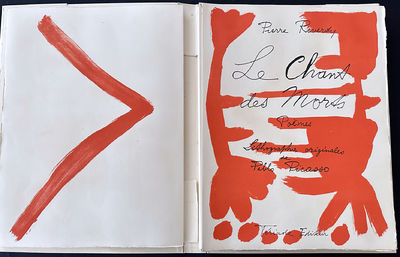
PICASSO. REVERDY, Pierre. Le chant des morts. Poems. Original lithographs by Pablo Picasso.
Pierre Reverdy & Pablo Picasso Paris, 1948 Tériade, Paris, 1948. Printed by Mourlot, Paris. Loose as issued, cover. folder and case. This edition was published in 1948 by Tériade and is printed from the poet's autograph copy. It is illustrated with 125 lithographs by Picasso (including 2 for the cover). Edition of 270 copies on Arches vellum, signed by Pierre Reverdy and Pablo Picaso: one of 20 out of commerce. Despite their long relationship, "Les Chants des Morts" is the only illustrated book Picasso and renown art reviewer and publisher Tériade ever collaborated on. Pierre Reverdy finished a series of 43 poems titled Le Chant des Morts and Picasso illustrated his handwritten manuscript page by page in the manner of old illuminated manuscripts, adding another layer of artistic expression to Reverdy's somber poems. The poems were written during the later years of World War II and explore themes of love, death, and the human condition often in a fragmented and surreal manner. Picasso's artwork in this book complements Reverdy's poetry by visually capturing the essence of the text and is often characterized by distorted and fragmented figures, bold lines, and vibrant colors. The illustrations serve as visual interpretations and extensions of Reverdy's words, deepening the reader's understanding and appreciation of the emotional intensity and existential themes present in Reverdy's poems. Ref: Cramer 50- $11,000
- $11,000
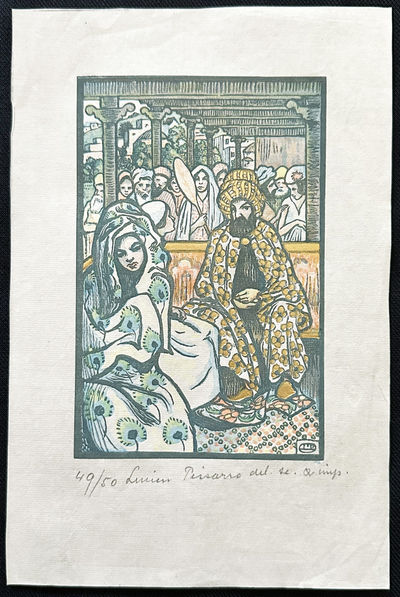
Histoire de la Reine du Matin et de Soliman Prince des Genies. Copy enriched with a suite of the engravings on China paper + two prints numbered
Lucien Pissarro Gerard de Nerval Hammersmith, 1909 Gerard de Nerval, Illustrated by Lucien Pissarro. Limited edition of 130 nominative copies on Arches pour fil paper, of which this one is the n 73 for Henry Michel-Dansac. Gerard de Nerval tale from the collection of Voyage en Orient, illustrated with Lucien Pissarro composition drawings, engraved in woodcuts by Lucien and his wife Esther, Pissarro. This copy is enriched with a suite of the engravings on China paper (except for the vignette on the justification page) + two prints, also on China paper, of an unselected plate the first mounted at the head of the volume (N 17/ 50), and the second on a loose leaf (N. 49/50). In artistic binder signed M. Lortic ( Marcelin Lortic), empire green morocco, large gilt frame on the covers composed of a double frieze and rosettes, ornate ribbed spine, the original olive gray calf cover with florals gilt motives embossed, is preserved inside. In very good condition.- $15,000
- $15,000
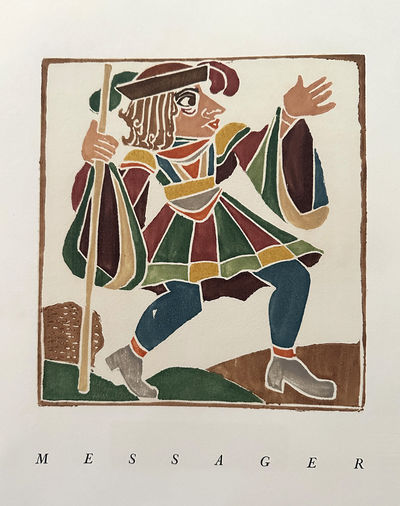
Les Horribles et espouvantables faictz et prouesses du très renommé Pantagruel Roy des Dipsodes fils de grand géant Gargantua. Derain’s main illustrated work, with 128 (21 full-page) original color woodcuts
André Derain. François Rabelais. Paris, 1943 François Rabelais, illustrated with colored woodcuts drawn and engraved by André Derain Limited numbered edition of 275 copies, of which this copy is on of 200 in Velin d Arches, signed by the artist on the justification page. Derain's main illustrated work, with 128 (21 full-page) original color woodcuts, 34 color woodcut initials and 18 color woodcut final vignettes. André Derain took full charge of the printing process from the carving of the wood blocks, in the manner of 15th-century cardmakers, to the coloring to which he added special attention to preserve the warm tone of his woodblocks, using a hand - coloring technique: all the wooden blocks had to be colored one after the other by a team of practitioners, in their nuances, according to a scheme established by the painter and repeated in each volume. Loose as issued in half parchment wrappers, chemise and slipcase. Text selection by A. Lefranc, illustrations printed by Andre Derain and Roger Lacourière. Light foxing at the margin, chemise in poor condition. Ref: The Artists and the Book 81.- $7,500
- $7,500
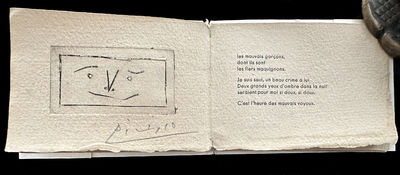
NUIT
Pablo Picasso, Rene Crevel, PAB Alès, 1956 Rene Crevel first edition of is poem NUIT, published in the "Autumn 1924, Winter 1925" issue of Little Review New York magazine, illustrated with an original engraving with burin on celluloid by Picasso signed in pencil. Oblong tiny format, 65 x 90mm, published by PAB Alès, May 1956. Limited numbered edition of 30 copies, printed on fine Auvergne laid paper by Richard-de-Bas, n. 29 signed in pencil by PAB (Pierre Andre Benoit) Ref: Cramer 74. Very Good, lightly tanned.- $20,000
- $20,000
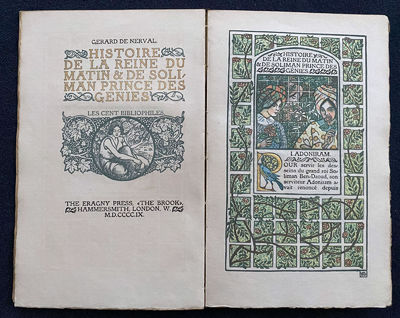
Histoire de la Reine du Matin et de Soliman Prince des Genies.
Gerard de Nerval, Lucien Pissarro. Gerard de Nerval, Illustrated by Lucien Pissarro. London Hammersmith, ERAGNY PRESS, for Les Cent Bibliophiles, 1909. Limited edition in 130 numbered and nominative copies, of which this one is the n 52 for M. Henry Hirsch. Gerard de Nerval tale from the collection of Voyage en Orient, illustrated with Lucien Pissarro composition drawings, engraved in woodcuts by Lucien Pissaro and his wife Esther. Frontispiece and Head-Letters in colors and gold. Bounded in the original publisher binding, in olive grey calf, with florals gilt motives embossed, guarded in a case and slipcase signed by Renaud Vernier, 1995. Rare edition in very good condition, few splits on the text block and light off-prints from the illustrations.- $8,000
- $8,000
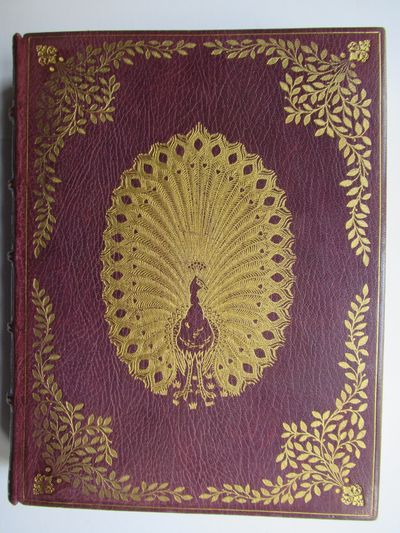
RUBAIYAT OF OMAR KHAYYAM
Omar Khayyam London, 1913 London: Hodder and Stoughton, 1913. Edition limited to 250 copies SIGNED by Rene Bull (this no. 123). Fine copy with tiny dark spot on the spine and minimal tide marks on a few of the tissue guards not affecting plates ot pages. Edition limited to 250 copies SIGNED by Rene Bull (this no. 123). Unpaged. Illustrated by Rene Bull with 10 full-page tipped-in color plates, 19 smaller mounted color plates, the remaining text plates with pictorial designs and borders printed in blue, title page highlighted in gilt. 4to. Bound by Zaehnsdorf in full purple crushed morocco with watered silk endpapers, a.e.g., the spine ornately gilt with titles and panel decorations, the upper cover features a large central gilt peacock design (6 1/2") in the style used on Zaehnsdorf's "Hafiz of Shiraz" (without the jewels) with elaborate frames of trailing vines, fancy dentelles. Potter no. 99.- $4,000
- $4,000
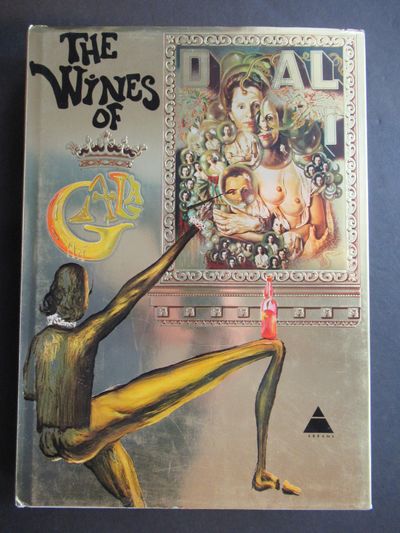
DALI: THE WINES OF GALA
Dali, Salvador New York, 1978 New York: Abrams, 1978. First edition in English. Nice copy in pictorial embossed gold foil dust jacket with minor scratching.. First edition in English. Tall quarto. 296p. Illustrated throughout in color by Dali. White cloth with gilt titles and color pictorial designs, illustrated endpapers.- $350
- $350
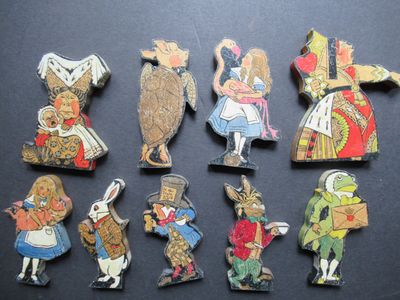
Alice in Wonderland stand-up figures
[Alice] Oxford, 1920 Oxford: The Alley Workshops, 1920. Nice bright condition with only minimal wear. Nine painted wooden figures of Wonderland characters, most about 3" tall - the Queen of Hearts taller of course - about 3 1/2" - each 3/8" thick. The figures include: Alice holding a piglet, Alice holding a flamingo, Mock Turtle, White Rabbit, March Hare, Frog Footman, Mad Hatter, March Hare, Duchess.- $375
- $375
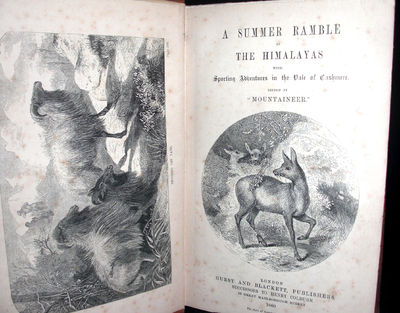
A Summer Ramble in the Himalayas, with, Sporting Adventures in the Vale of Cashmere
Wilson, William London., 1860. London. Hurst and Blackett. 1860. Bound in original publisher's pictorial gilt decorated brown cloth. 8vo. 6" x 9 The First Edition. Edited by "Mountaineer. Illustrated by an engraved Frontis and Title Page. Covers mildly soiled and rubbed. Corners a bit bumped. Sporadic foxing throughout. Spine unobtrusively cracked at Pg. 240. Repair to endsheet at rear gutter. A previous owners ink signatures to front paste down and front free endsheet. A Very-Good, crisp copy. Very rare in original cloth.- $425
- $425
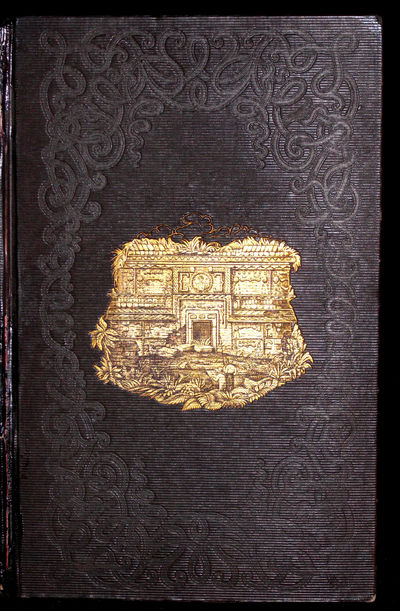
Rambles in Yucatan Including a Visit to the Remarkable Ruins of Chi-Chen, Kabah, Zayi, Uxmal and C
Norman, B. M New York., 1843. New York. J.& H.G. Lanangley 1843. Bound in original publisher's pictorial gilt decorated brown cloth. 8vo. 6"x9 The First Edition. Illustrated throughout by maps and full-page plates. Chipping to head piece. Well executed repairs to spine cloth at gutter. Pastedowns and endsheets somewhat soiled. previous owners ink signature and small label to front pastedown. Occasional mild sporadic foxing. A Very-Good crisp and bright copy. Carey & Hart #307.- $200
- $200
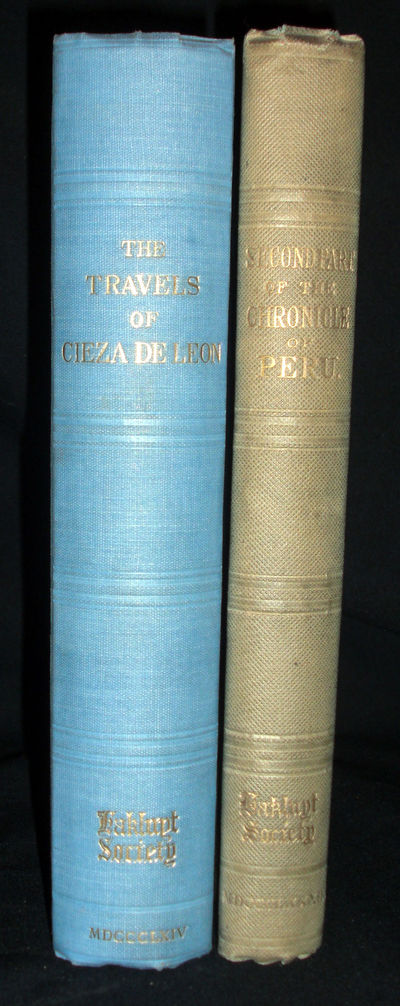
The Travels of Pedro De Cizea De Leon, A.D. 1532-50,- The Chronicle of Peru
De Leon, Pedro De Cieza London., 1864- 1883 London. Hakluyt Society. 1864- 1883 Bound in pictorial gilt titled and decorated blue cloth. Blind embossed decorations to front and rear covers. 8vo. 6" x9 The First Edition of the First Part (1864), the First Edition of the Second Part (1883). With 1864 Report of the Hakluyt Society bound-in to front of Vol. I. Illustrated by one linen-backed, hand-coloured folding map depicting Peru, Quito and new Granada Spine of Volume II sunned. Small previous owner's stamp to front-pastedowns. Sporadic mild foxing to map with offset to Title Page. A Very Good, crisp and bright copy of this extremely rare Issue.- $1,500
- $1,500
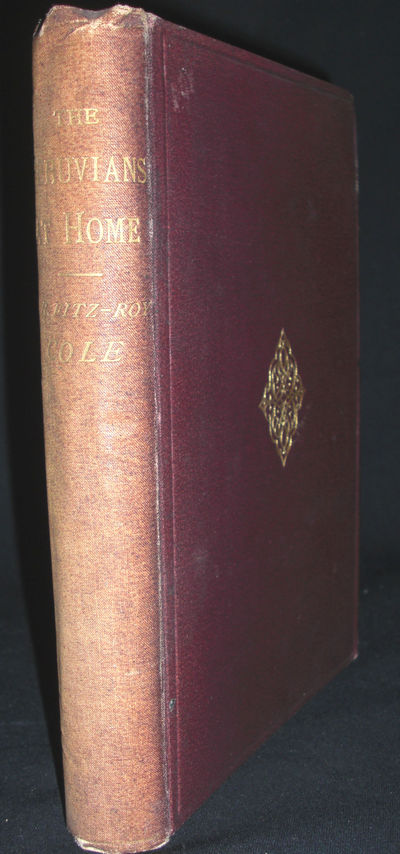
The Peruvians at Home
Fitz-Roy Cole, George R London., 1884 London. Kegan Paul, Trench and Company 1884 Bound in original publisher's pictorial gilt decorated burgundy cloth. 12mo. 5.5"x7.5 The First Edition. Slight lean. Covers mildly rubbed. Mild sunning to spine. Small previous owners rubber stamp to front pastedown. Light water stain to rear free endsheet ( not intruding further into text block). A Very-Good copy. An extremely rare Title, with no other extant copies presently noted.- $1,500
- $1,500
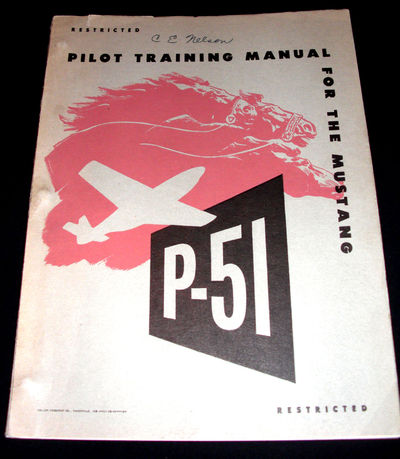
Pilot Training Manual for the P-51 Mustang
Washington D. C., 1944. Washington D. C. Headquarters-U.S. Army Air Forces. 1944. Punch and clipbound in stylized titled coloured pictorial wrappers. Thin 4to. Classified "Restricted" and marked as such on each page.This manual is for the P51-B and C, with several pages at end detailing the "Teardrop" D type - which was still in production at the time this manual was produced. Profusely illustrated with photographs, drawings, maps, diagrams, charts, etc. The P-51 Mustang was,with little argument, the single greatest American Fighter Aircraft of World War 2. The sleek, low winged Mustang was among the very first to use a laminar-flow wing, which resulted in far less drag. Also, the P-51 had its wingtips, rudder, and elevators with square-cut ends, unlike almost every other aircraft at the time. It paid off, as the P-51 could reach 380mph while the lighter Spitfire, with half as much fuel weight, could not get within 15mph of that figure. The P-51 Mustang, designed in 1940 after Great Britain requested that North American build P-40 Warhawks for the Royal Air Force, was at first ignored by U. S. officials. However, the design showed such promise that in 1941 the Army Air Forces took delivery of P-51A's powered by the Allison V-1710 engine. These early Mustangs were restricted to reconnaissance and ground attack due to the limited performance of the Allison engines. Tests in 1942 with the Roll-Royce "Merlin" engine showed a marked increase in performance. By the end of 1943, Merlin powered P-51Bs entered combat with the 354th Fighter Group in England. Eighth Air Force Mustangs provided long range escort to B-17s and B-24s and scored heavily over German interceptors. By the war's end, P-51s had destroyed 4,950 enemy aircraft in the air, more than any other U. S. fighter in Europe. Mustangs served in nearly every active combat zone, including the Pacific where they escorted B-29s from Iwo Jima to Japan. Between 1941 and 1945, the Army Air Force ordered 14,855 Mustangs. During the Korean Conflict, P-51's were used primarily for close support of ground forces until withdrawn from combat in 1953. P-51s served with Reserve and National Guard units until 1957. Ink stamp of Salem Army Airdrome HQ dated 1945 to title Page and inside rear cover. Tiny tear to top edge of cover. Owners name in ink to front cover.Small chip to top of spine.Various small stains at spine on rear cover. Usual rust offset from metal binding pins to front and rear inside covers. to front and rear inside covers. A remarkably preserved, clean and crisp copy of this most rare and desirable relic.- $2,500
- $2,500

Pilot Training Manual for the P-38 Lightning
Washington D. C., 1944. Washington D. C. Headquarters-U.S. Army Air Forces. 1944. Punch and clipbound in stylized titled coloured pictorial wrappers. Thin 4to. Classified "Restricted" and marked as such on each page. The December 1944, Original "Brown Cover" issue. Profusely illustrated with photographs, drawings, maps, diagrams, charts, etc. During its time, the Lockheed P-38 Lightning was considered the most sophisticated aircraft Lockheed had ever built. In February 1937, the U.S. Army Air Corps released Specification X-608, a daunting requirement that called for speed, range, and climb capabilities impossible to achieve at that time with a single-engine aircraft. In Burbank, California, a Lockheed design team led by Hall Hibbard, and assisted by a young engineer named Clarence "Kelly" Johnson, immediately began a series of designs that would culminate in the contract-winning XP-38. Jim Gerschler became project engineer on the aircraft. The XP-38 (it was many months before it was called the Lightning) was of an extraordinarily advanced conception, an all-metal, midwing monoplane with twin Allison engines using General Electric turbo-superchargers, a central nacelle for the pilot and armament, contra-rotating propellers, twin-booms and rudders, and a tricycle landing gear. Nothing like it had ever been seen before, and it would be the only single-seat, twin-engine aircraft to reach mass production status during World War II. The distinctive sight and sound of the Lockheed P-38 Lightning would make it one of the best-known aircraft of the war. First flown on January 27, 1939, by one of its staunchest advocates, Air Corps 1st Lieutenant Ben Kelsey, the prototype XP-38 made national headlines when it crashed on a transcontinental record-setting attempt. Nevertheless, imminent war in Europe accentuated the need for the Lockheed P-38 Lightning, and production orders began to flow in. By war's end, a total of 10,037 P-38s had been built. As it was much more modern than the Curtiss P-40, there was a great demand in every theater of war for the twin-engine fighter. The big Lockheed P-38 Lightning had its greatest successes in the Pacific Theater, where the two leading aces, Majors Richard I. Bong and Thomas B. McGuire, scored 40 and 38 victories, respectively, using only the Lightning. The Lightning was also the only plane capable of carrying out the extraordinary 800-mile mission that climaxed with the shoot-down of the Mitsubishi "Betty" carrying Admiral Isoroku Yamamoto on April 18, 1943. Not as maneuverable as the Japanese fighters, the Lockheed P-38 Lightnings used dive and zoom tactics and their formidable center-line firepower of four .50-inch machine guns and a single 20-mm cannon to gain victories. It gave its pilots confidence on the daily long-distance flights over water, for if one engine was lost to combat or accident, the Lightning was able to limp home on the other. The Lockheed P-38 Lightning was less at home in Europe, where its large size made it less maneuverable than the German fighters it faced. Further, its Allison engines didn't operate as well at the high altitudes and cold temperatures of the European Theater. It became a workhorse nonetheless, doing duty in bomber escort, reconnaissance, and bombing, carrying as much as 4000 pounds of bombs in the latter role. One version of the P-38 was modified with a "droop-snoot" and carried a bombardier and either a Norden bombsight or a radar set. About 1,400 Lockheed P-38 Lightnings were completed as F-4 and F-5 reconnaissance planes, which were flown, unarmed and unafraid, deep within enemy territory. There were more Lightning reconnaissance planes than any other type in the USAAF. The Lockheed P-38 Lightning set many records. It was the only USAAF fighter to be in production prior to the start of the war and still in production on VJ-Day, August 15, 1945. It was the first fighter with sufficient range to make ferry flights across the Atlantic. It was also the first fighter for which compressibility problems were forecast, and among the first to experience compressibility. The P-38 was the first fighter to use power-boosted flight controls as well as the first to have a tricycle landing gear. Curiously, Lockheed did not have much luck in creating advanced versions of the Lightning. The more powerful XP-49 and XP-58 took too long to mature, and neither was successful. It really didn't matter, for the Lockheed P-38 Lightning was capable of doing all that was required of it. -The Editors of Publications International, Ltd. Several small splits to spine. Several tiny chips/creases to to fore-edge of front cover. Very mild Usual mild wear from metal binding pins to front and rear inside covers. A sensational, well preserved, clean copy.- $3,000
- $3,000
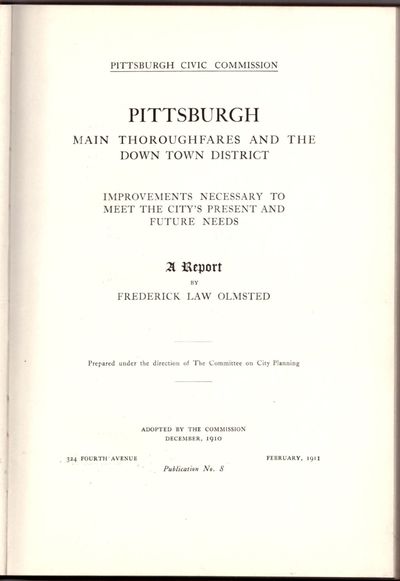
Pittsburgh Main Thoroughfares and the Down Town District: Improvements Necessary to Meet the City’s Present and Future Needs
Olmsted, Frederick Law Pittsburgh, PA, 1911 Pittsburgh, PA: Pittsburgh Civic Commission, 1911. First Edition. Hardcover. Fine/fair. Frederick Law Olmsted Jr.'s (1870-1957) seminal report that drove future development for the City of Pittsburgh. xvi, 169 pp. 4to. Original dust wrapper is missing numerous pieces, but still somewhat protective of covers. Burgundy cloth boards with gold embossed titling to cover and spine, clean and crisp within. Three maps: one very large with multiple folds, two bifold -- all in Fine condition. Heavily illusrated throughout, a fascinating example of city planning recommendations in the early 20th century.- $300
- $300
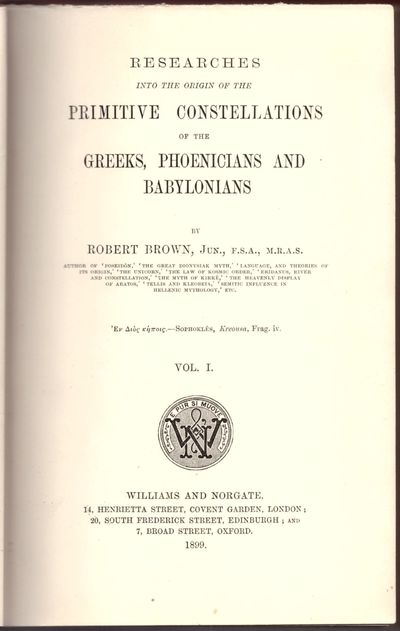
Researches Into the Origin of the Primitive Constellations of the Greeks, Phoenicians and Babylonians (2 Volumes)
Brown, Robert London, 1899/1900 London: Williams and Norgate, 1899/1900. First Edition. Hardcover. Good. xv, 361, xx, 261 pp. 8vo. Red cloth boards with wear and scuffing, sunning to spines of each volume. Losses to head and foot of each volume, cloth split halfward won on front hinge of Volume II. Minor darkening of endpapers from age and quality of paper, clean within. Folding plate at p. 118 in Volume I is in Very Good condition as well as plates a frontispiece and p. 148 of Volume II.- $150
- $150
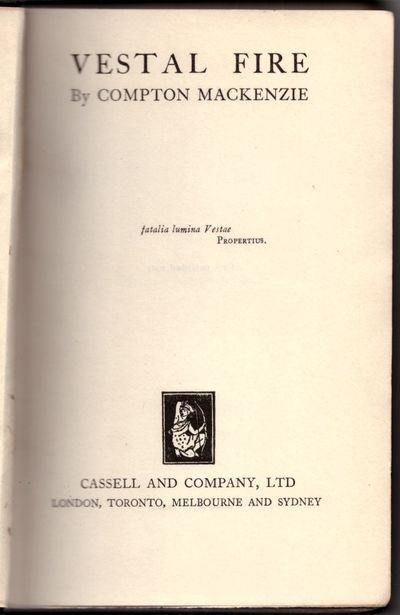
Vestal Fire
Mackenzie, Compton London, 1927 London: Cassell and Company, Ltd, 1927. First Edition. Hardcover. Very Good. First Printing. ix, 421 pp. Dark blue cloth boards with gold embossed titling to spine. Corners bumped with minor losses, minimal creasing at head and foot of spine. Slight lean to volume, clean within.- $150
- $150
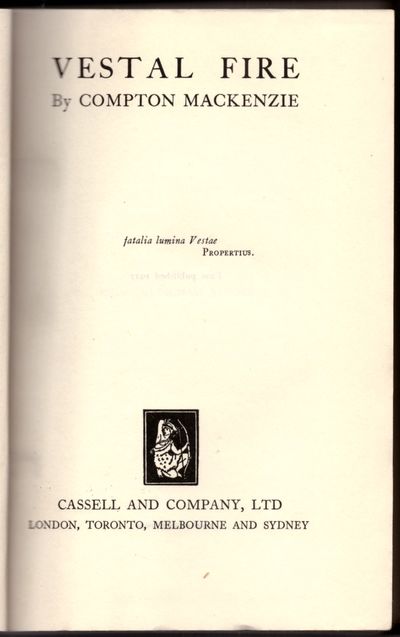
Vestal Fire
Mackenzie, Compton London, 1927 London: Cassell and Company, Ltd, 1927. First Edition. Hardcover. Very Good. First Printing. ix, 421 pp. Dark blue cloth boards, gold embossed titling to spine has faded completely. Corners bumped with tiny losses, ealy book shop sticker on lower left corner of front pastedown, clean within.- $100
- $100
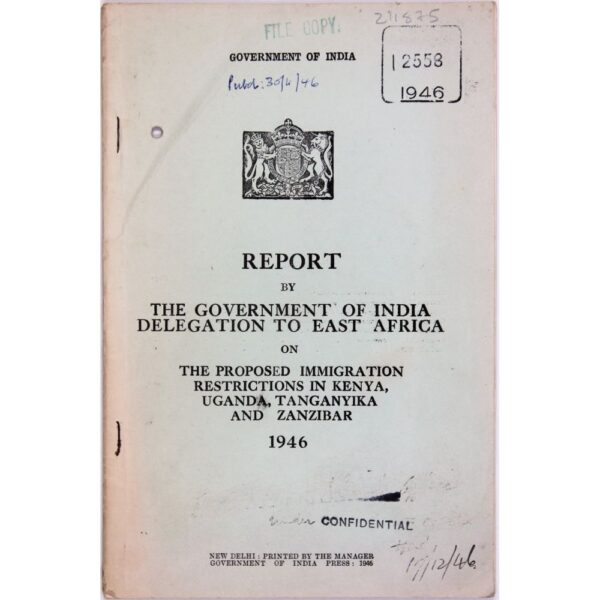
Report by the Government of India Delegation to East Africa on the proposed immigration restrictions in Kenya, Uganda, Tanganyika and Zanzibar, 1946.
First edition, pp.51. A very good copy in original wrappers. Small punched hole for filing with minimal loss of text. A scarce report published in an edition of 500 copies only, stamped FILE COPY, CONFIDENTIAL, in which the Indian Government makes a plea for access for Indian immigration to British East Africa.- $116
- $116
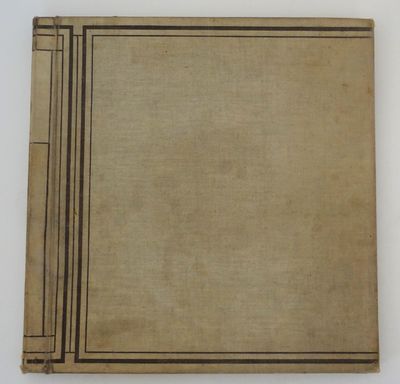
Frank Lloyd Wright
Santpoort, Holland, 1925 Hard cover Square folio 13" by 13" Cream cloth over boards. 164 pages. Pages lightly toned. Cover shows shelf wear, particularly to spine ends, and marks to spine otherwise very good. An introduction by architect H. Th. Wijdeveld and many articles by famous European architects and American writers.- $350
- $350
![Refranes o Proverbios Españoles traduzidos en lengua Francesa. Proverbes Espagnols traduites en François. [Part 2:] GARAY](https://rarebookinsider.com/wp-content/uploads/2024/03/1562862987.0.l.jpg)
Refranes o Proverbios Españoles traduzidos en lengua Francesa. Proverbes Espagnols traduites en François. [Part 2:] GARAY, Blasco de. Cartas en Refranes
OUDIN, César (ca. 1560-1625) Lyon, 1614 Lyon: Pierre Rigaud, 1614. 12mo (132 x 70 mm). [2], 376 pages (last 3 blank leaves removed). 2 parts, separately titled but continuously signed and paginated. Spanish text in roman types, French translation in italic. Pagination errors, signatures with crooked sorts on h4r and h6r. Woodcut printer's device on general title, a metalcut headpiece, woodcut initials. Upper margins cut close, shaving a couple of headlines. 19th-century brown morocco, bound for William Stirling Maxwell, with two different blind-stamped monograms on covers, spine gilt lettered, gilt edges, red endpapers (upper joint broken). Provenance: William Stirling Maxwell (1818-1878), supralibros, Keir House "Proverbs" collection bookplate (rear pastedown), small armorial bookplate with his "I am ready," etc. mottos (front pastedown); with Quaritch, collation note 1958; with Maggs, 1993, catalogue 1160, no. 27; Kenneth Rapoport, bookplate.*** Only Lyonese edition of a popular collection of over 2000 Castilian proverbs with French translations, first published in 1605, by a lexicographer, royal interpreter, and the first translator of any part of Don Quixote into French (part 1, published the same year as this edition). For each proverb the Spanish and French texts are printed together in one paragraph, differentiated by their type fonts. Gratet-Duplessis praised Oudin's proverb collection as the best French source for Spanish proverbs, noting the precision of the French translations, and the utility of Oudin's short explanatory notes. Pierre Rigaud, the printer of this edition, did not do the text justice; frequent incorrect spellings and weird punctuation occasionally render either the translations or the originals nonsensical (e.g., "La mujer que poco hila, sempre trae mala camisa" is translated as "La femme qui peut filer [instead of peu file], toujours, porte meschante chemise" - p. 95). This edition follows the Brussels 1608 edition in adding a second part, containing a 16th-century epistolary jeu d'esprit by the inventor Blasco de Garay: a series of letters composed entirely of proverbs and aphorisms. It concludes with the Dialogo entre un viejo e amor, a dramatic poem first published in 1511, attributed to Rodrigo Cota de Maguaque, in which Love persuades an old man who had been resigned to his solitude to try again, and then proceeds to mock him cruelly. An appealing copy of a scarce edition. USTC, OCLC and NUC give 4 US locations (Hispanic Society, UC Berkeley, NYPL and U. Penn). Palau 207295; USTC 5005619 & 6901883; Gratet-Duplessis, Bibliographie parémiologique 495 (1659 edition).- $1,950
- $1,950
![Refranes o Proverbios en Romance. [Part 2:] MAL LARA](https://rarebookinsider.com/wp-content/uploads/2024/03/1562862981.0.l.jpg)
Refranes o Proverbios en Romance. [Part 2:] MAL LARA, Juan de (1524-1571). La Filosofia Vulgar
NUÑEZ DE GUZMAN, Hernán (1474?-1553) Madrid, 1619 Madrid: por Juan de la Cuesta, a costa de Miguel Martinez, 1619. 4to (212 x 147 mm). [4], 399 leaves. 2 parts, separately titled but continuously signed and foliated. Printer's woodcut device on titles. Double column, woodcut head-piece, tail-piece, and initials. Underlining in pink and blue pencil in second part; scattered foxing, occasional marginal staining or soiling, a couple of short marginal tears due to paper flaws (M3, V1). Contemporary parchment, title ink-lettered on spine, evidence of two fore-edge ties; a few deckle edges (later endpapers). Provenance: Kenneth Rapoport, bookplate, inserted purchase notes.*** The "most complete and most useful edition" (Gratet-Duplessis) of Nuñez's vast proverb collection, first published in 1555, comprising over 8500 short sayings, including some Portuguese, French, Italian and Galician proverbs. The longer second part contains Juan de Mal Lara's Filosofia vulgar (fol. 121 ff.), a more discursive selection of proverbs, first published in 1568. Mal Lara's extensive and erudite commentary could be considered too long in places (noted Gratet-Duplessis), but it is redeemed by his wit and above all his citation of a large number of little-known Spanish poems (ibid., p. 294). The edition concludes with Garay's Cartas en refranes (see Oudin). Iberian Books B4409; CCPB CCPB000037314-1; Palau 253490 & 197518; Salvá 2112; Heredia 2763; Gratet-Duplessis, Bibliographie parémiologique 486 (Garay p. 292).- $1,500
- $1,500
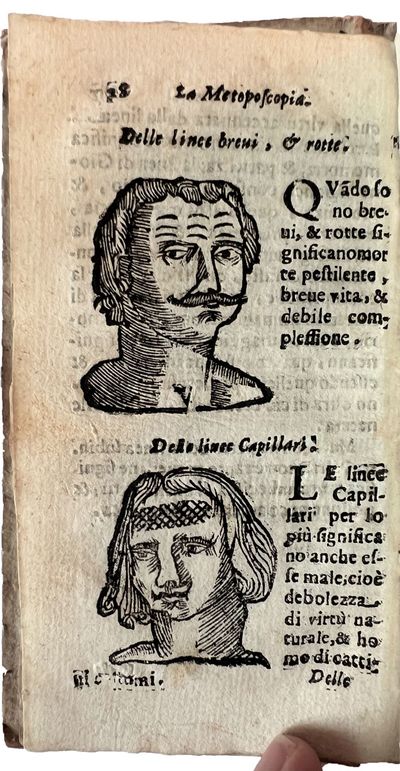
La Metoposcopia overo Commensuratione delle linee della fronte … Aggiuntovi una breve, e nuova Fisonomia, un Trattato dei Nei, & un’altro dell’Indole della persona, con molte curiosità
SPONTONE, Ciro (ca. 1555-1612), attributed to Venice & Verona, 1672 Venice & Verona: Andrea Rossi, 1672. 12mo (142 x 75 mm). Collation: A-F12 G4 (G4 blank). 150 pages. Forty-six woodcuts, of which one full-page, woodcut title ornament and initials. Wormtrack in gutter of last few leaves, affecting few letters on pp. 144-145, else a fine, fresh copy, untrimmed, in its original carta rustica binding.*** Rare pocket edition of a popular early manual of physiognomy, with crude woodcuts of male heads, all looking slightly concerned, as their simplistically lined foreheads each bear the burden of a different character type. The work was first published in an elegant octavo edition in 1626. In the dedication of that edition, Giovanni Battista Spontoni, doctor from Peschieria, claimed to have found the work in his father's papers. Ciro Spontone (or Spontoni) served as secretary to high-placed dignitaries and diplomat; he wrote serious literary works, and this posthumously published foray into pseudo-science contrasts oddly with the rest of his oeuvre. The Dizionario biografico degli Italiani does not include it among his works. The present economically printed "popular" edition, whose poor models suffered at the hands of the remarkably unskilled wood engraver, is augmented with a short treatise on other aspects of physiognomy (the nose, the eyebrows, teeth, lips, voice, etc.) for men and women, and chapters on beauty marks and on human proportion. ICCU ITICCUBVEE34899, a different issue(?) of this edition, with the same imprint and bibliographical fingerprint, but in which the last quire contains six leaves instead of four (3 Italian locations listed; OCLC adds Heidelberg); Caillet, Manuel bibliographique des sciences psychiques ou occultes 3: 10327.- $1,400
- $1,400
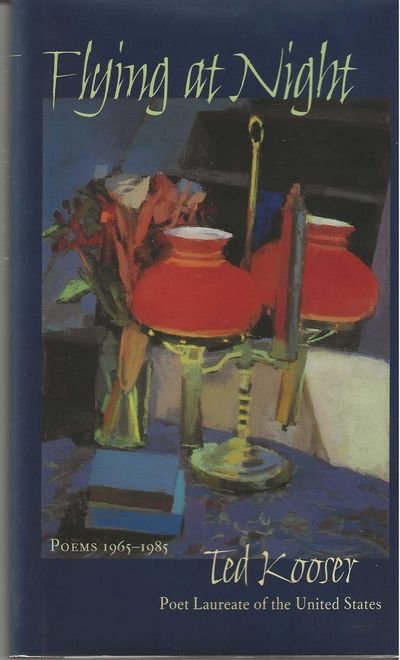
FLYING AT NIGHT: POEMS 1965-1985
Kooser, Ted Pittsburgh, 2005 Pittsburgh: University of Pittsburgh Press, 2005. 1st edition, full navy blue cloth, with illustrated dust jacket. Specially signed by Kooser on the title page in black ink. For the present title "Kooser has selected poems from two of his earlier works, SURE SIGNS and ONE WORLD AT A TIME" (Pittsburgh Press web site). Quite scarce in cloth, and especially so signed. Bright, fine condition.- $225
- $225
THE BLIZZARD VOICES
Kooser, Ted. (Tom Pohrt, illus.) Minneapolis, 1986 Minneapolis: Bieler Press, 1986. 1st edition, limited (1/200) numbered and signed, decorated boards, without dust jacket (as issued). A collection of poems, "a dramatized narrative of the devastation unleashed by the great blizzard of January 12, 1888" (from the prospectus, laid in). Signed by Kooser and Pohrt on the colophon page. There was a second issue of this title in paperwraps, published at a later time. Prior owner's neat signature to the FEP, else fine.- $300
- $300
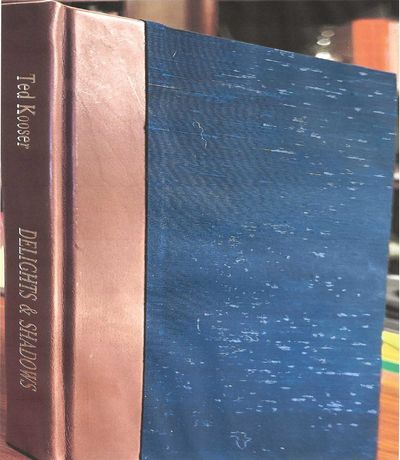
DELIGHTS & SHADOWS
Kooser, Ted Port Townsend, 2004 Port Townsend: Copper Canyon Press, 2004. 1st edition, limited (1/26) lettered and signed, leather and cloth bound, without dust jacket (as issued). A collection of fifty-nine poems arranged in four sections. This title won the Pulitzer Prize for poetry in 2005. The present copy is designated letter "C" on the colophon page, and signed in full by Kooser on the title page in black ink. Bright, fine condition.- $300
- $300

MEADOWLANDS
Gluck, Louise Hopewell, 1996 Hopewell: Ecco Press, 1996. 1st edition, cloth spine, with illustrated jacket (as issued). Specially inscribed and signed by Gluck on the title page in blue ink. A collection of forty-six poems, arranged in a book-length sequence. Gluck is the recipient of the National Book Critics Circle Award, the Pulitzer Prize, and most recently the Nobel Prize in Literature (2020). Fine condition.- $225
- $225
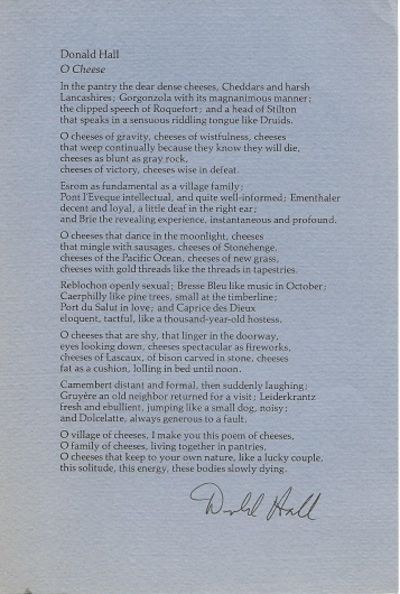
O CHEESE. (Broadside.)
Hall, Donald n.p., n.d.. 1st edition, broadside. Specially signed in black ink by Hall. As described in the Kelleher bibliogrphy: "6 x 9 inches; black print on light blue paper. Note: This version includes two extra stanzas not found in the version that appears in KICKING THE LEAVES (Harper & Row, 1978), and OLD AND NEW POEMS (Ticknor and Fields, 1990)" from the Hall bibliography (Kelleher G6). Believed to be the earliest separate printed version of this poem -- one of Hall's trademark verses. Very scarce broadside.- $150
- $150
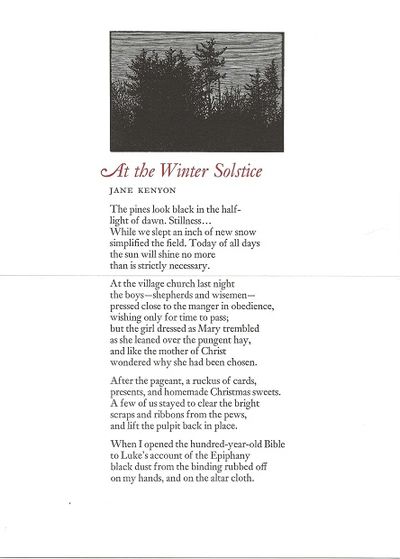
AT THE WINTER SOLSTICE. (Broadside.)
Kenyon, Jane. (Barry Moser, illustrator.) Concord, NH, 1996 Concord, NH: Ewert, 1996. 1st edition, limited (1/650) illustrated broadside. Illustrated with a relief engraving by Barry Moser, printed directly from the block by the artist. Printed on fine stock, 10.5 inches high x 7.5 inches wide when opened, in two color ink at Firefly Press. Published as a Christmas card for Donald Hall, and issued folded for mailing. A beautiful, bright copy of this scarce Kenyon/Moser broadside. Fine condition.- $100
- $100
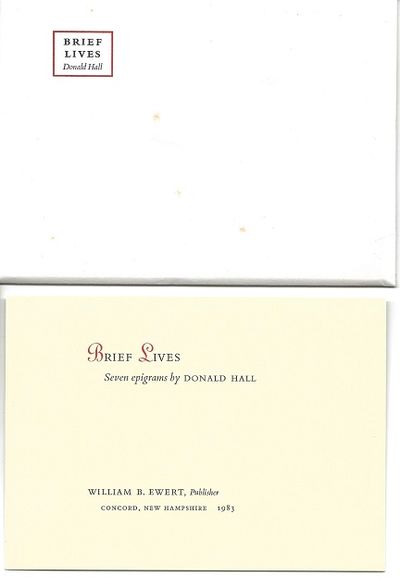
BRIEF LIVES: SEVEN EPIGRAMS
Hall, Donald Concord, 1983 Concord: Ewert, 1983. 1st edition, limited (1/136) numbered and signed, card stock, with printed envelope (as issued). Each epigram is printed on a separate card in two color ink, and signed by Hall on the numbered colophon card. The entire publication consists of twelve printed cards enclosed in one printed envelope. (Kelleher A22) Quite scarce. Fine condition.- $125
- $125
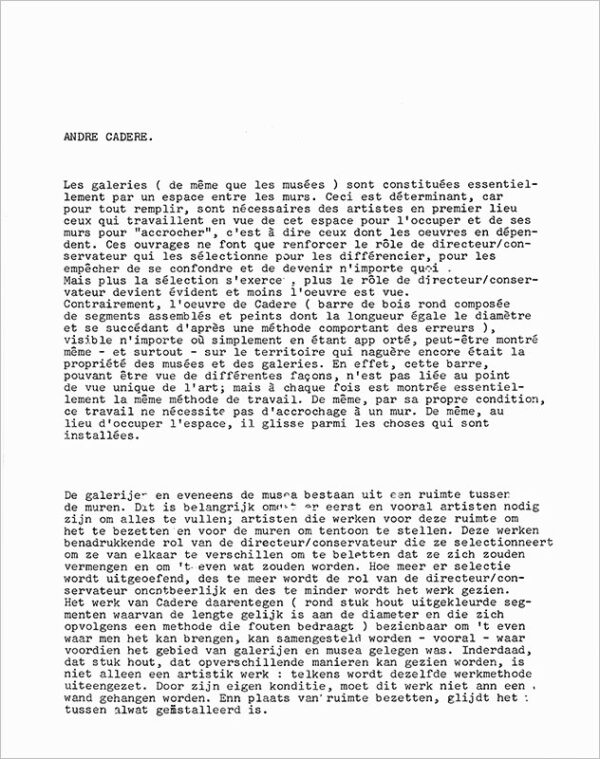
Les Galeries (the galleries )
CADERE, André Activity report. Artist's broadsheet. Typed text in black, in both French and Dutch on a sheet of white paper, on one side. 27.4 x 21.5 cm. Important text on Cadere's work by himself (.) "This bar, which can be seen in different ways, is not linked to the unique point of view of art; but each time is shown essentially the same working method. Also, by its own condition, this work does not require hanging on a wall. Likewise, instead of occupying space, it slips among the things that are installed". Fine.- $733
- ARCHIVES |
- $733
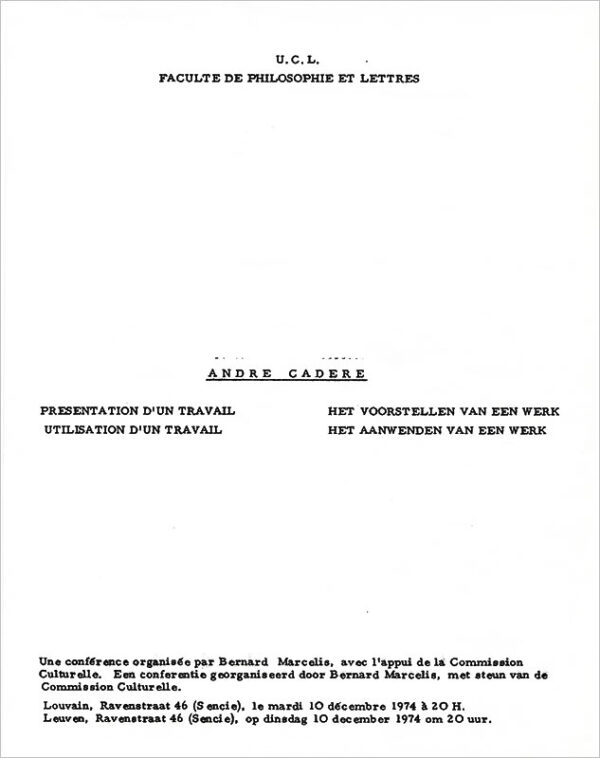
Présentation d’un travail – Utilisation d’un travail
CADERE, André Announcement. Printed black on a sheet of white paper, on one side. A conference organized by Bernard Marcelis at the U.C.L. (Catholic University of Louvain, Belgium), Tuesday, December 10, 1974. Text in both French and Dutch. One of the fundamental elements of Cadere's work. The text of this conference was then published in book form by Edition Lebeer Hossmann, Hamburg and MTL, Brussels, 1975.- $507
- ARCHIVES |
- $507
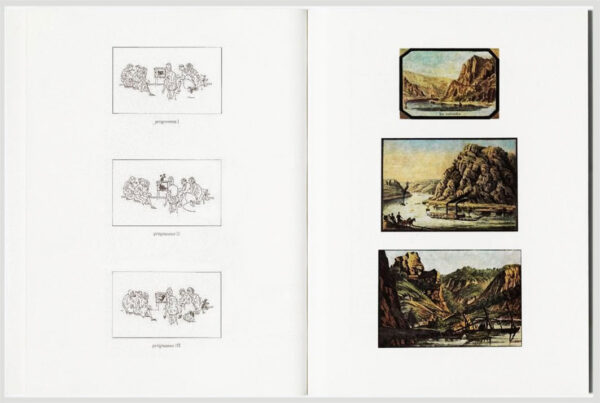
En Lisant la Lorelei. Wie ich die Lorelei gelesen habe
BROODTHAERS, Marcel Artist's book. Unpaginated (28pp.). 2 pages of a text by M. Broodthaers (foreword by the artist and the text of Heinrich Heine's poem "Die Lorelei", in German and French on opposite pages). Letterpress. Only reproductions of which 6 in colors: seven full page facsimiles of drawings from German and French stock exchange tables, six pages of drawings incorporating reproductions of commercial chromolithographs, and six pages of reproductions from the romantic period of the Henrich Heine's poem, "die Lorelei". Publisher's white wrappers. Printed on Zeta Mattpost paper. First edition of only 116 (100+10+6), handnumbered in black ink in the colophon page, -this copy numbered 30/100- bearing the rubber stamp Estate M. Broodthaers" (The edition was intended to be signed by M. Broodthaers, but due to his untimely death the copies were signed with the estate stamp: Estate Marcel Broodthaers ). 32 x 24.5 cm. Fine with a few black ink printing marks (from the printer) on the front cover: thin pale black horizontal and vertical short lines. References: Ceuleers & Van de Velde, 2012: Marcel Broodthaers, The Complete Prints and Books L'oeuvre graphique complète et les livres - Het complete grafische werk en de boeken, n°45. M. Werner, Köln, 1982: M.B., Catalogue of books, #21, p. 58-59. Jamar: Marcel Broodthaers - Complete Graphic Work & Books 44.- $2,085
- ARCHIVES |
- $2,085
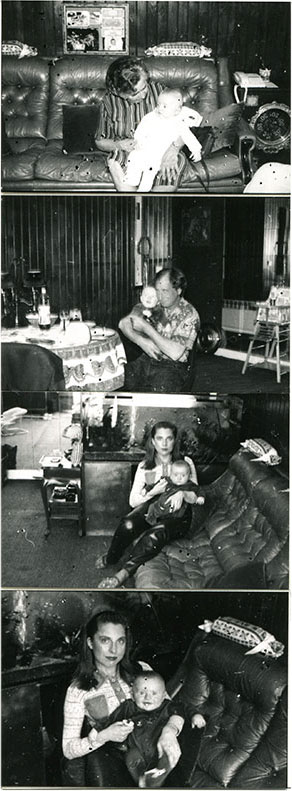
Die Familie Kushmist
(RENARD, Hubert) NUSSBICKER, Erik Artist s publication. Eight (8) found black and white photos printed on glossy paper, accordion folded. Each photo: 10.8 x 7.4 cm. Inside a white card paper folder with flap, 7.5 x 11 cm. From the Château Landon s Collection. Mailed to a friend in Paris. As new.- $101
- ARCHIVES |
- $101
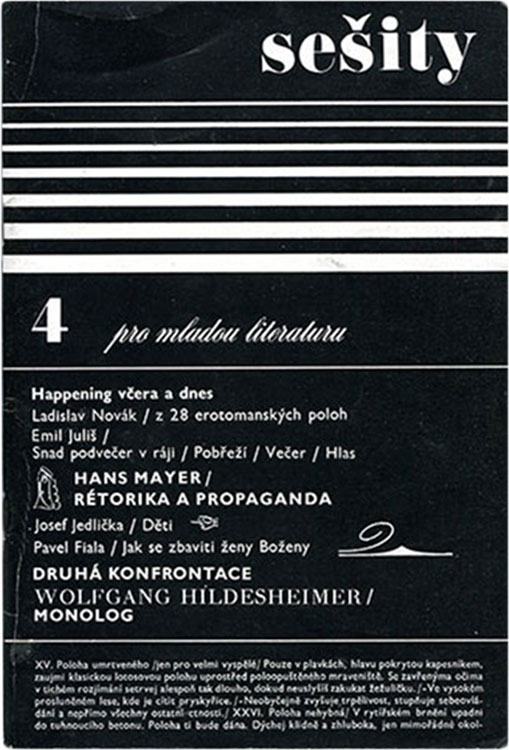
SESITY 4/66 “Pro mladou literaturu” (for a young literature) and SESITY 3/1 “Pro lieraturu a diskusi” (for literature and discussion).
(Zdenek Herman (pdt.); Petr Kabes (dir. publ;) SESITY 4/66: "Pro mladou literature" (for a young literature). Publication 10 times a year. 4th issue of 1966, first year of publication. 64pp. Text in Czech. Many illustrations in b/w. Stapled bound. Soft cover. 28 x 19.2 cm. Very good condition. SESITY 3/1: "Pro lieraturu a diskusi" (for literature and discussion). First issue of the fourth year of publication, May 1969. 64 pp. Text in Czech, many illustrations in b/w. Stapled bound. Soft cover. 28 x 19.2 cm. Very good. Both issues: Participation of all the artists of the Czech avant-garde. See the pictures of the front covers and of the summaries, including the editorial boards, the list of all the major Czech avant-garde artists and writers participating in the issues. General design for both issue: Milan Knizar.- $135
- ARCHIVES |
- $135
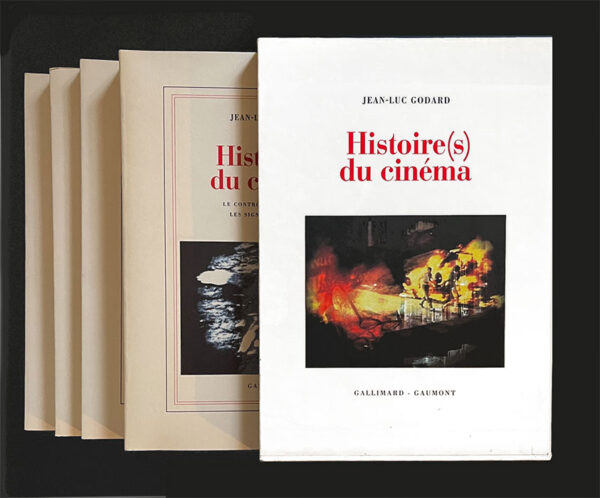
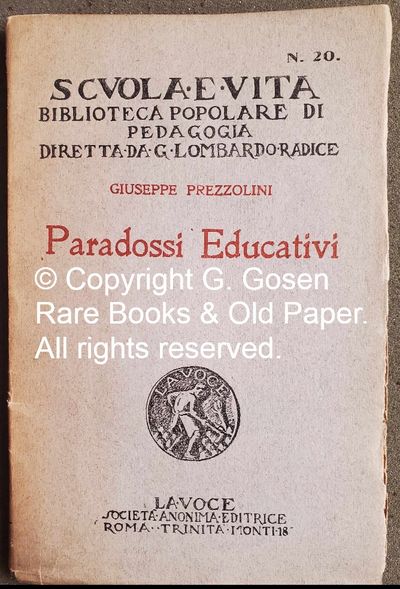
Paradossi Educativi.
Giuseppe Prezzolini Roma, 1919 Prezzolini, Giuseppe. Paradossi Educativi. Scuola e Vita Biblioteca Popolare di Pedagogia Diretta da G. Lombardo Radice N. 20. Società Anonima Editrice, Roma, Trinità Monti 18, 1919. First edition. 8vo, 18.5 cm. The original gray paper wrapper with red and black lettering and the printer's mark of a man tilling his garden on the front cover and an advertisement for L'Educazione Nazionale of G. Lombardo-Radice on the back cover. The original price of 2 lire appears at the foot of the back cover. [91 pages, Nota, indice; 4 pages of advertisements for Istituto Bibliografico Italiano, Roma]. This copy is signed, inscribed and dated by Prezzolini: "all'amico Riccio GPrezzolini N.Y. 1927." Mostly unopened, this rare surviving inscribed copy records the nexus of Riccio, a first-generation Italian American, with Prezzolini, whose legendary "Voice" was far more than a review and was a publication of enormous importance to Italian culture and intellectual life. The paper is browning at the edges and is fragile. True to form, and ever the visionary, Prezzolini's first essay from 1914 is entitled, "La Coltura Popolare." Contact us for a full description.- $575
- $575
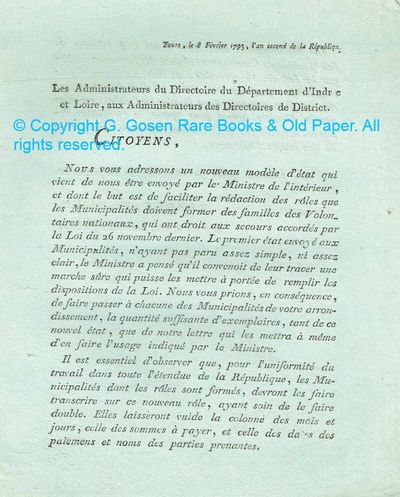
Les Administrateurs du Directoire du Département d’Indre et Loire, aux Administrateurs des Directoires de District.
Chalmel and Bergey Tours, 1793 Broadside, 22.5 cm x 17.5 cm, printed on both sides, bluish laid paper, horizontal chain lines, no watermark. An announcement of relief and survivor benefit for the families of volunteers, nos braves Défenseurs, as the French revolutionary army of 1792 began the process of reorganization and re-invention to a larger fighting force through the call for volunteers fired by patriotic zeal by the Government. These volunteers were fired by a sense of "civic virtue" and "public responsibility." By the external threat of foreign armies, like Austria's, the new Republic made its continued existence out to be under threat and called on every citizen to defend it.Condition fine. Contact us for a full description and English translation.- $525
- $525
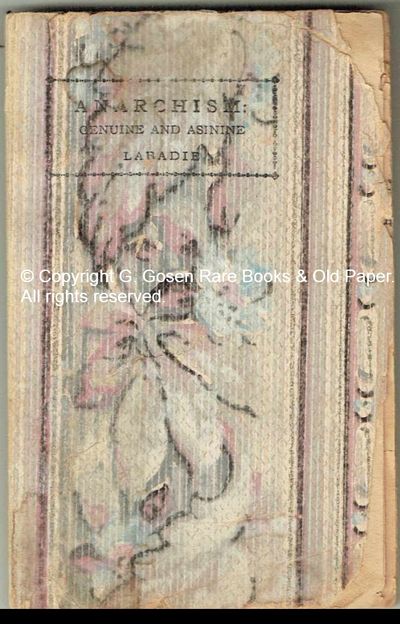
ANARCHISM Genuine and Asinine by Jo Labadie.
Labadie, Jo Wixom, Mich., 1925 Labadie, Joseph A. ANARCHISM Genuine and Asinine by Jo Labadie. The Labadie Shop, Bubbling Waters, Wixom, Mich., USA, 1925. First edition. 41 pages. 14 cm, 5 ½ in, frontispiece portrait of Labadie. 6 in-text cartoon illustrations. Printed on the verso of uncut advertising sheets for The Federal Reserve Money from the Modern Publishing Company. Labadie starts his booklet with a manicule pointing at: "This Booklet is not copyrighted." The first chapter is "The Great Copyright Swindle." Following are "The State"; "Anarchism and Crime"; "What 'tis and 'tisn't"; "Anarchy to Toil"; "The Paramount Need"; and, "Imperialism." Bound in wallpaper, back wallpaper cover is now missing. The text paper is acidic and fragile. Labadie's portrait is on polished paper, which helps keep this creative utilitarian binding secure.- $500
- $500
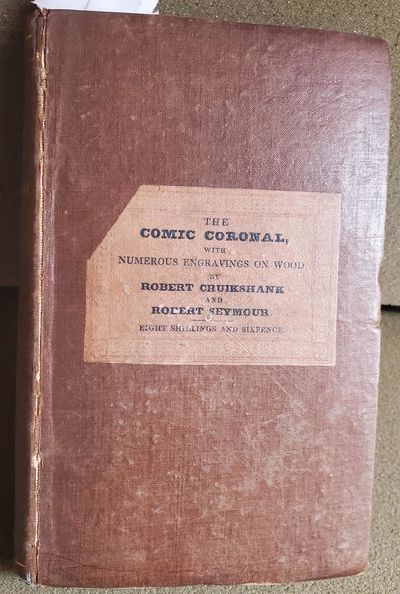
The Comic Coronal, or, Book of Merriment.
Charles Dibdin John Taylor Robert Cruikshank Robert Seymour London, 1830-31 Cruikshank, Robert and Robert Seymour, Charles Dibdin and John Taylor. The publisher's front cover label is: The Comic Coronal, with Numerous Engravings on Wood by Robert Cruikshank and Robert Seymour. Eight Shillings and Sixpence. Inside, the full title: The Comic Coronal, or, Book of Merriment. With Numerous Illustrations on Wood by Robert Cruikshank and Robert Seymour. London: William Kidd, 228, Regent Street, and Sold by All Booksellers. Bound in the publisher's original brown cloth with a paper label on the front cover. Stamped gilt lettering on the spine. Front hinge cracked but still internally strong. 16 cm. 6mo. Interiors of the six volumes are in fine condition. The title page for the first of six separately paginated volumes is: Walks About Town; a Poem, in Two Cantos, with Notes, and a Memoir of the Authors; by the Antiquated Trio. Illustrated with Three Engravings on Wood, after the Designs of Robert Cruikshank. Second Edition. London: Effingham Wilson, Royal Exchange. 1830. Please contact us for a complete description.- $1,650
- $1,650
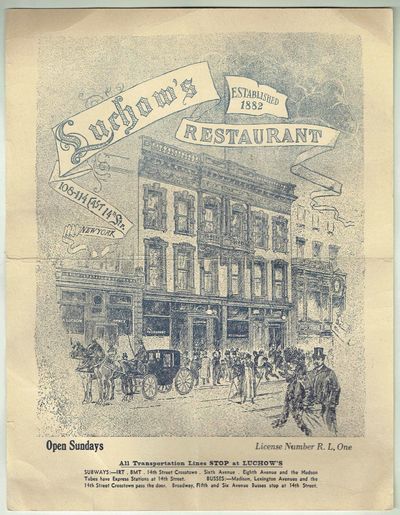
Luchow’s Restaurant Established 1882, 108 – 114 East 14th Str., New York. Menu for Wednesday, September 6, 1944.
Luchow's Restaurant New York, Sept. 6, 1944 Luchow's Restaurant Established 1882, 108 – 114 East 14th Str., New York. Menu for Wednesday, September 6, 1944. One sheet of heavy paper, 12 7/8 in x 10 in, with a lithographed artist's rendering of the façade of Luchow's Restaurant circa 1890 on the recto/front. The verso/back lists the war-time luncheon offerings for Wednesday, September 6, 1944.Please contact us for a full description.- $250
- $250
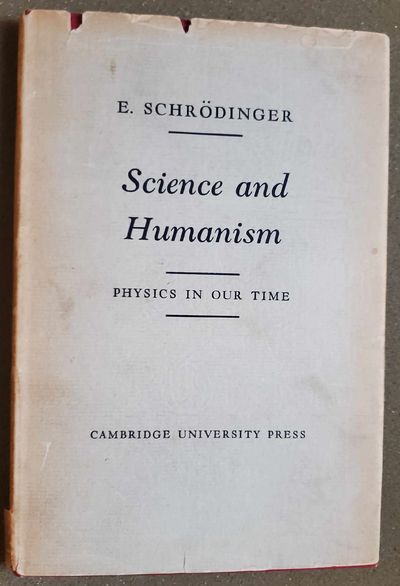
SCIENCE AND HUMANISM Physics in Our Time by Erwin Schrödinger Senior Professor at the Dublin Institute for Advanced Studies.
Schrodinger, Erwin Cambridge, 1951 Schrodinger, Erwin. SCIENCE AND HUMANISM Physics in Our Time by Erwin Schrödinger Senior Professor at the Dublin Institute for Advanced Studies. Cambridge, at the University Press, 1951. 68 pages. Page 68 is a bibliography. 7 ¾ in; 18.6 cm. Crimson cloth with gilt lettering on the spine, faded gray-green dust jacket with the publisher's advertisement on the back panel. Book is fine, dust jacket is chipped, soiled but intact.- $350
- $350
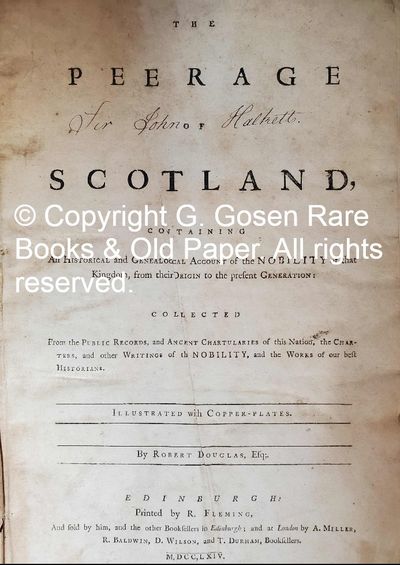
The Peerage of Scotland
Douglas, Robert Edinburgh, 1764 Robert Douglas THE PEERAGE OF SCOTLAND 1764 Signed by Sir John Halkett and Elizabeth GC Menzies with the Bookplate of Pitfirrane Castle. Douglas, Robert, Sir 1694 – 1770. The Peerage of Scotland, Containing An Historical and Genealogical Account of the Nobility of that Kingdom, from their Origin to the Present Generation: Collected from the Public Records, and Ancient Chartuleries of this Nation, the Charters, and Other Writings of the Nobility, and the Works of our Best Historians. Illustrated wth Copper-Plates. By Robert Douglas, Esq. Edinburgh: Printed by R. Fleming, and Sold by him, and the Other Booksellers in Edinburgh; and at London by A. Miller, R. Baldwin, D. Wilson, and T. Durham. M, DCC, LXIV. [1764] Imperial quarto, 14 ¾ in x 9 ½ in; 37.5 cm x 23.3 cm. [xi (verso of xi blank); 740 pages]; 10 full-page plates of coats of arms, 12 to a plate. ESTC T148734. Bound with six raised bands, with a leather spine on contemporary marbled paper-covered pasteboard covers, with a gilt lettered label. The leather hinges are cracked, but the covers remain secure. This complete copy has multiple sequential errors of pagination. This copy has the signature of Sir John Halkett 1720 - 1793, the Fourth Baron of Pitfirrance on the titlepage and the bookplate of his Pitfirrane Castle library, with the motto, "Fides Sufficit." Below the shelf mark on the initial blank "C-1" is the pencil signature of Elizabeth "Betty" G.C. Menzies dated by her in 1970. Please contact us for a full description.- $950
- $950
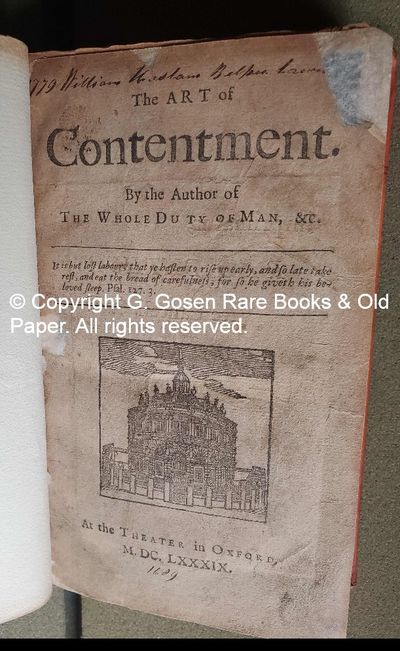
The Art of Contentment
Richard Allestree Oxford, 1689 [Allestree, Richard], The Art of Contentment. At the Theatre in Oxford, 1689. Second impression. 18cm, 8vo, 214 pages plus a table of contents. Wing A1165. Title page backed with Japanese paper on which the book plate of Alfred Seal Haslam has been remounted on the verso, taken from an earlier binding. The modern binding is full brown calf with five raised bands and a gilt title label. The title page bears the signature of William Haslam dated 1799, believed to be the father of Alfred Seal Haslam, who took over his father's business. Trained as an engineer, Alfred Seal Haslam patented a new method of ammonia compression, enabling him to transport meat from Australia under refrigeration, holding a monopoly for some fourteen years on marine meat transport. Allestree was a prominent royalist divine and credited with an enormously popular group of self-improvement books, including The Whole Duty of Man (1654), The Gentleman's Calling (1660), The Ladies Calling (1673), The Government of the Tongue (1674) and The Art of Contentment (1675).- $600
- $600
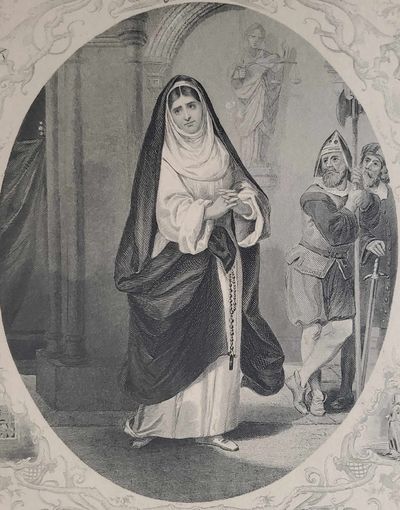
Fanny Kemble (Butler) as Isabella in Shakespeare’s MEASURE FOR MEASURE
Thew, Robert New York, 1859 Thew, Robert. Fanny Kemble (Butler) as Isabella, "Merciful Heaven!" New York: Johnson, Fry & Co., 1859. Engraving, portrait print by Robert Thew of Frances Anne "Fanny" Kemble Butler (1809-1893) in costume as Isabella in William Shakespeare's Measure for Measure. The sheet measures 10 in x 7 ¼ in, with a vignette-decorated border of scenes from the play around an oval image, showing Fanny Kemble Butler in a full-figure pose. Once an illustration in a book, now disbound, with original tissue guard still attached, now torn. Slight chipping of the upper right-hand corner of the sheet, with no image loss.- $900
- $900
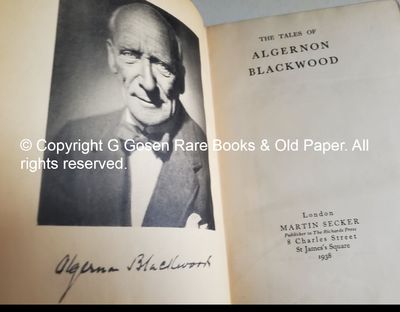
The Tales of Algernon Blackwood.
Blackwood, Algernon London, 1938 The Tales of Algernon Blackwood. London: Martin Secker, Publisher to the Richards Press, 8 Charles Street, St. James's Square, 1938. Signed on the portrait frontispiece, from a photograph by Douglas Ltd., by Algernon Blackwood (1869-1961). 25 cm. Blue cloth, no dust jacket. The spine is creased and sunned but not broken. The book block is solid and secure. 8vo. [xv; 684 pages; 2 blanks] A collection of twenty-two of Blackwood's ghost stories printed between 1906 and 1910, printed here in chronological sequence, with an introspective introduction by the author.- $600
- $600
RAILWAY MAP LONDON UNDERGROUND TRANSPORT, 1934, No. 2. ISSUED FREE.
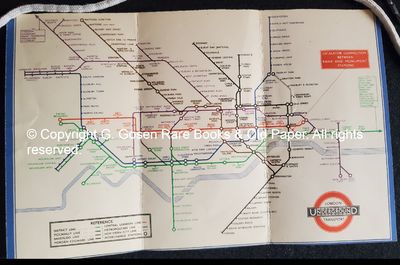
Beck, H. C. London, 1934 [London. Underground] H. C. Beck, Henry Charles Beck, RAILWAY MAP LONDON UNDERGROUND TRANSPORT, 1934, No. 2. ISSUED FREE. Printed by Johnson Riddle & Co. for London Transport, 55 Broadway, Westminster, S.W.I, Victoria 6800. Signed in lower left-hand corner below the reference, "H. C. Beck." This 1934 underground railroad pocket map was issued just one year after Henry Charles Beck's revolutionary railroad map design made its first appearance in 1933. Beck's first design maps ran from 1933 to 1938. On the back, verso, are listed Places of Interest and Theatres, a feature replaced with a schematic design map of Interchange Stations Central Area on subsequent maps in Beck's first series design. 14.5 cm x 25.8 cm. This map's blue border was trimmed slightly to fit into a pocket diary, where it was preserved in good condition.- $375
- $375
Essays Upon Several Moral Subjects. In Two Parts.
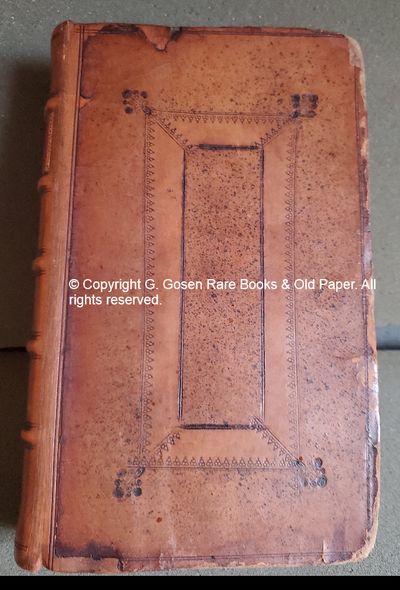
Collier, Jeremy, M.A. London, M DCC III. [1703] Collier, Jeremy, M.A., Essays Upon Several Moral Subjects. In Two Parts. The Fifth Edition. London: Printed for Richard Sare at Grays-Inn-Gate in Holborn, M DCC III. [1703] Parts I and II paginated separately as follows: Part I [viii; 246 pages; 1 leaf with advertisements recto and verso]; Part II with title page stating "Printed by W.B. for H. Rhodes, at the Star, the Corner of Brides-Lane, Fleet Street; and T. Newborough, at the Golden-Bull in St. Paul's Church Yard. 1705." [viii; 200 pages] Page 124 in numbered incorrectly as 224 in Part II. Bound with Part III, In-8, "Printed by W.B. for H. Rhodes, at the Star, the Corner of Brides-Lane, Fleet Street; and T. Newborough, at the Golden-Bull in St. Paul's Church Yard. 1705." [title-page; v (preface); i (Errata and Table on the verso of v); 279 pages]. Parts I and II, ESTC Cit. No. T110889, Part III, ESTC Cit. No. T110888. Parts I and II appeared first in 1694 and 1695 respectively. Re-backed, 5 raised bands; original stamped paneled tan calf covers preserved. A very bright, crisp, and clean copy of Parts I and II. Part III has some slight foxing and browning, but still a very good copy.- $850
- $850
A COLLECTION OF TWENTY-SEVEN FIRST EDITIONS, IN DUST JACKETS, ALL BUT FOUR SIGNED
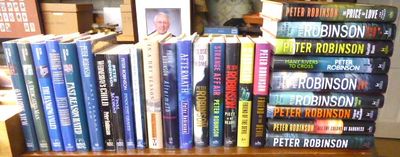
ROBINSON, PETER Various Places: Various Publishers Books and jackets are in fine condition. All are in the DCI Banks series. They are listed here: "Gallow View", 1987, 1st Canadian, signed; "A Dedicated Man", 1988, 1st Canadian, signed; "The Hanging Valley", 1st Canadian, signed; "The Hanging Valley", 1992, 1st US, unsigned; "Past Reason Hated", 1991, 1st Canadian, signed; "Past Reason Hated", 1993, 1st US, unsigned; "Wednesday's Child", 1992, 1st Canadian, signed, heavy card covers; "Final Account", 1994, 1st Canadian, signed, heavy card covers; "Innocent Graves", 1996, 1st Canadian, signed, heavy card covers; "Dead Right", 1997, 1st UK, signed; "In a Dry Season", 1999, 1st US, signed; "Aftermath", 2001, 1st Canadfian, signed; "Aftermath", 2001, 1st US, signed; "Close to Home", 2003, 1st US, signed; "Strange Affair", 2005, 1st US, signed; "Piece of my Heart", 2006, 1st US, unsigned; "Friend of the Devil", 2007, 1st Canadian, signed; "Friend of the Devil", 2007, 1st US, signed; "All the Colours of Darkness", 2008, 1swt UK, signed; "All the Colors of Darkness", 2009, 1st US, signed; "Children of the Revol;ution", 2013, 1st UK, signed; "Abattoir Blues", 2014, 1st UK, signed; "Sleeping in the Ground", 2017, 1st UK, signed; "Careless Love", 2018, 1st UK, signed; "When the Music's Over", 2016, 1st UK, signed; "Many Rivers to Cross", 2019, 1st UK, signed; "The Price of Love and Other Stories", 2009, 1st US, unsigned, with an Inspector Banks novella. Postage will be extra for this large group of titles.. Signed by Author. First Editions. Various Bindings. Fine/`Fine. Octavo.- $600
- $600
THE NATURALIST’S LIBRARY, ICHTHYOLOGY
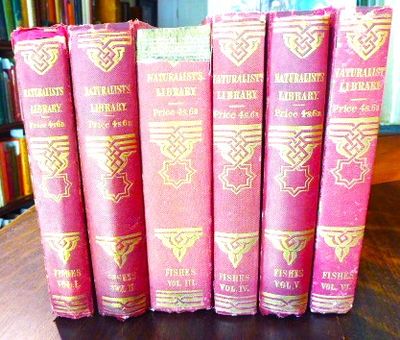
JARDINE, SIR WILLIAM Edinburgh, 1852 Edinburgh: W.H. Lizars, 1852. SIX VOLUMES UNIFORMLY-BOUND.Spines decorated and lettered in gilt.Top edges gilt. Yellow endpapers. Various dates from 1852-1854. Top of spines chipped, with 1/2 " piece missing top of spine Volume 3. Occasional old water-stains sparing plates. Collated complete with 197 full-page hand-colored plates with tissue guards, six portraits and six vignette title-pages. Several plates are loosened. Each volume has a biographical memoir at front with portrait frontispiece of the featured natural historian. Volumes 35-40 of the larger series. Volume 1, "Fishes", Volume 2, "British Fishes, Part 1", Volume 3, "British Fishes, Part 2"; Volume 4, "Fishes of the Perch Family"; Volume 5, "Fishes of British Guiana, Part 1"; and Volume 6, "Fishes of British Guiana, Part 2". See photos. . Later Bantam Reprint. Red Cloth. General Corner and Edge Wear/No Dust Jackets. Small Octavo.- $500
- $500

PAGES AND PICTURES, FROM THE WRITINGS OF JAMES FENIMORE COOPER
COOPER, SUSAN FENIMORE New York, 1861 New York: W.A. Townsend and Company, 1861. Professionally rebacked with original spine laid-down, hinges repaired. Blind-stamped cover and spine designs, lettering in gilt. All edges gilt. Marbled endpapers. Most pages toned, some foxing occurring, usually peripherally. A large and heavy book of 400 pages. Illustrated throughout with forty steel engravings, seven wood engravings, and 120 head and tail vignettes, many by F.O.C. Darley. Illustrated title-page and frontispiece portrait of Cooper. The full-page illustrations are protected by tissue-guards. A nicely-repaired and preserved tribute to the author by his daughter. See photos. . First Edition. Full Brown Leather. Edges and Corners Worn./No Dust Jacket. Small Thick Quarto.- $100
- $100
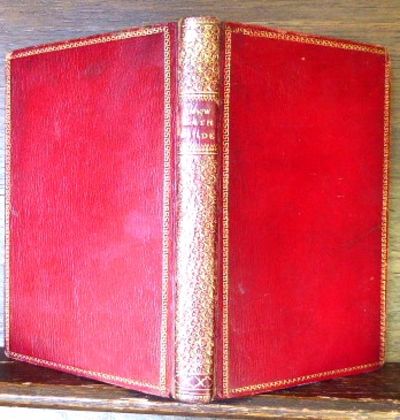
THE NEW BATH GUIDE: OR, MEMOIRS OF THE B-N-R-D FAMILY, IN A SERIES OF POLITICAL EPISTLES
(ANSTEY, CHRISTOPHER) London, 1807 London: Vernor, Hood, and Sharpe, 1807. Gilt borders both covers. Spine embellished with floral designs, lettered in gilt. All edges gilt.Red leather name-plate front pastedown. Old yellow endpapers. Nine full-page illustrations, including frontispiece.Inscription of a front preliminary page dated 1821. A series of fifteen poetical letters satirizing the fashionable 18th century lifestyle in Bath. First edition published in 1760. Our copy has a bonus of a DOUBLE FORE-EDGE PAINTING! Both paintings appear to be scenes around the city of Bath, one suggests the "Circus". 154pp. + 4pp. adverts. Please see photos.. New Edition. Full Red Morocco. Light edge and Corner Wear/No Dust Jacket. 6 1/4" x 4".- $900
- $900
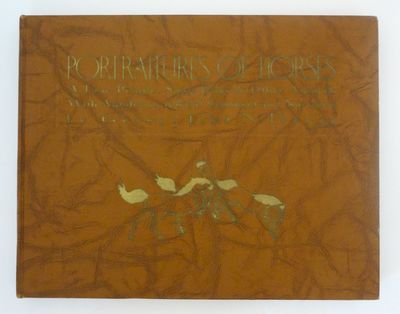
Portraitures of Horses
Morris, George Ford Fordacre, Shrewsbury, New Jersey, 1952 Oblong quarto. Hardcover. Textures brown faux leather with gilt titles. 280 pages profusely illustrated in b/w and color along with autobiographical comment and narrative by the author. Very good but NO dust jacket. "Being a collection of more than five hundred reproductions of the artist's and author's work in oil, water color, pastel, crayon, charcoal, pen and pencil, as well as of his lithographs, etchings silhouette cut-outs and sculpture, accompanied by autobiographical notes and comment covering a professional career of more than sixty-five years of effort in "attempted portrayals of animals ad their friends."- $205
- $205